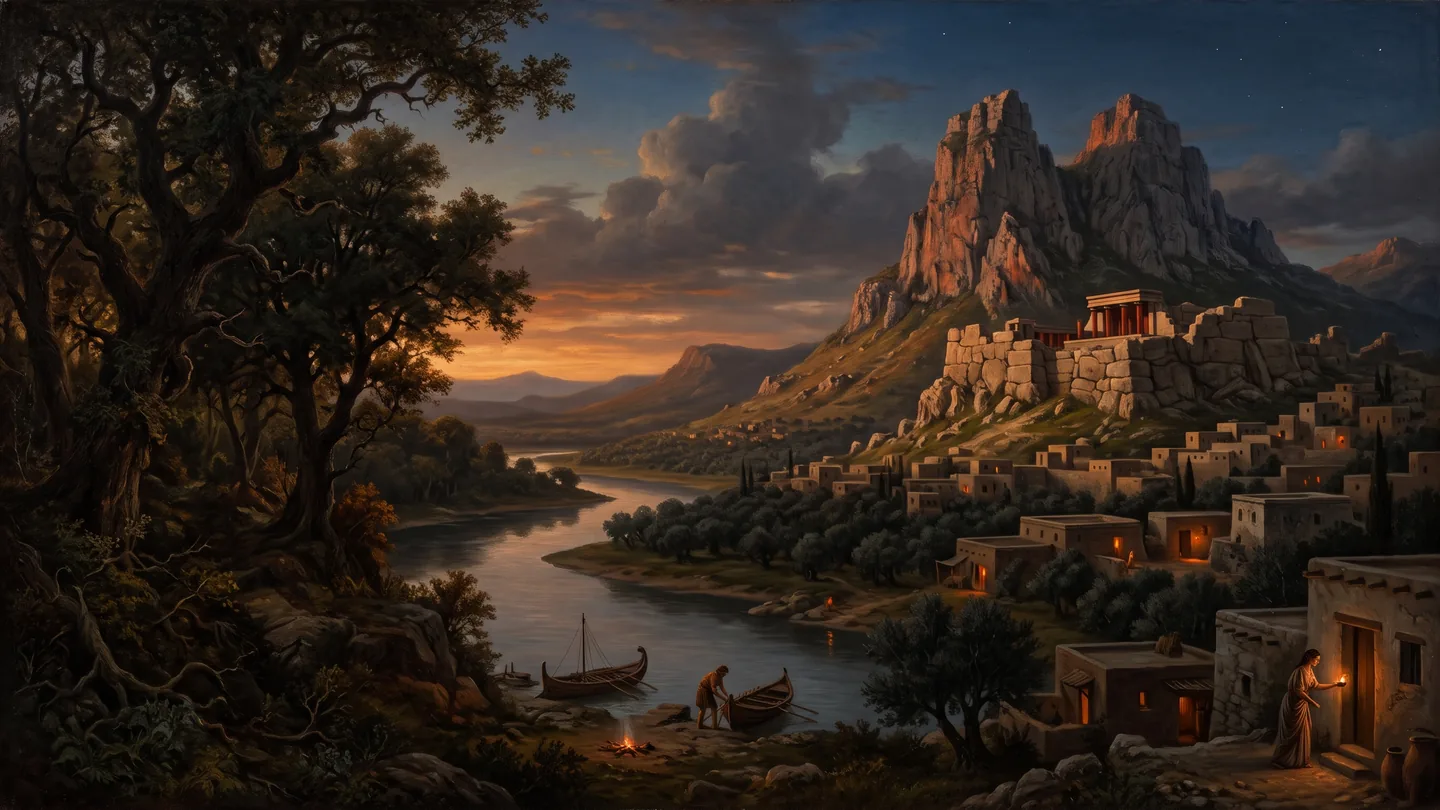
What you start with
Every new nation starts in the Bronze era. The start is small on purpose, so each early decision is easy to see.
- One capital cityIts City Center starts with only your palace and a few basic buildings, so your first new building has a clear job.
- Starter treasury and stockpilesEnough money, food and materials to make your first choices.
- Bronze era researchYour first research topics lead toward the Classical era.
- Bronze era lawsA starting government you can reform later.
- Guided StartWalks you through the first decisions with your real nation.
- Peace ModeFor your first 7 days, no nation can declare war on you. For the next 7 days, only nations with a Nation Score up to 1.25 times yours can.
How time works
Statefall runs in real time on a shared game clock. Buildings, research, shipments and events finish on that clock whether you are online or not. Refreshing the page more often does not speed anything up.
- ReadOpen Overview. It shows warnings, running work and what is getting worse.
- DecidePick the problem that matters most and choose how to respond.
- CommitQueue a building, start research, place a market order or change a law.
- WaitThe game clock moves your work forward, even while you are offline.
Then you read Overview again. A normal visit is a short review and a few decisions. There is no fixed schedule.
What you manage
These systems share the same money, goods and time, so a choice in one of them changes what you can do in the others.
Cities and buildings
Each city has a City Center and zones. You choose what to build where. Construction, repairs and storage upgrades share one queue.
Food and storage
Your people need food and other essentials. When storage is full, production stops and shipments have nowhere to unload.
Research
Research unlocks buildings, laws, units and resources. It opens the choice; you still build or fund what it unlocks.
Government and laws
Laws decide who holds power, how order is kept and how the economy runs. Reforms need administrators and public support.
Market and shipments
Buy and sell goods with other players. A market order becomes a shipment that needs a route and room to unload.
Alliances and diplomacy
Contact other nations, sign treaties, send aid, and join an alliance to plan with other players.
Military and war
Raise and supply forces to defend your nation or to declare war once you reach the Classical era.
Recovery
A lost war or a bad event damages cities and output. It does not delete your nation, and you choose what to repair first.
A worked example: growth creates a new decision
In Statefall, a good decision can create a new problem to solve. The steps below show one example.
What happens in your game depends on your nation. The order stays the same: find the problem, choose a response, wait for the result, and check again.
-
The city grows
A bigger city eats more food and needs more storage, services, and construction.
-
Food stores run low
Having some food in stock is not always enough. If people eat it faster than it arrives, it runs out. Overview and the Storage page show how many days of food you have left.
-
You choose a response
You might build more food or storage, start research, fix a slow shipment route, or buy food on the market if you have market access and room to store it.
-
The response has a cost
Construction uses up goods and waits in the project queue. A market purchase costs money and arrives as a shipment after a delay. A policy choice can change how your government and people behave.
-
The world updates
Production, use of goods, queues, shipments, and events all move forward with each update. A shipment that arrives late does not undo a shortage that already happened.
-
You read the consequence
Go back to Overview and the page for the affected area. If the problem is getting better, leave it alone. If it is still getting worse, look for the next cause instead of repeating the same action.
Eras you can play now, and eras planned
A new nation starts in the Bronze era. The alpha covers the Bronze and Classical eras. Four later eras are planned and are not in the game yet. Inside an era, your research, buildings, laws, contact with other nations, shipping, State capacity, and army technology decide what you can do.
| Era | Status | What it covers |
|---|---|---|
| Bronze era | Playable now | Food, authority, storage, early crafts, early laws, local defense, and your first State capacity. |
| Classical era | Playable now | Roads, iron tools, public law, coinage, ports, taxes, civic institutions, and organized armies. |
| Medieval | Planned | Estates, towns, guilds, castles, universities, written records, and sieges. |
| Early Modern | Planned | Gunpowder, printing, state finance, bureaucracy, dockyards, early factories, and ocean-going fleets. |
| Industrial | Planned | Coal, railways, steel, factories, ministries, labor disputes, public services, and mass warfare. |
| Modern | Planned | Oil, electricity, electronics, aviation, welfare, advanced shipping, intelligence, cyber warfare, and combined armies. |
Military power is one part of the game
You can focus on production, research, government, trade, diplomacy or alliance work. War matters, but it is not the only way to affect the world. You can also stay independent: other players still trade with you, read your public record, and react to what you do.